TLDR: What Does Vending Machine Service Actually Cost in California?
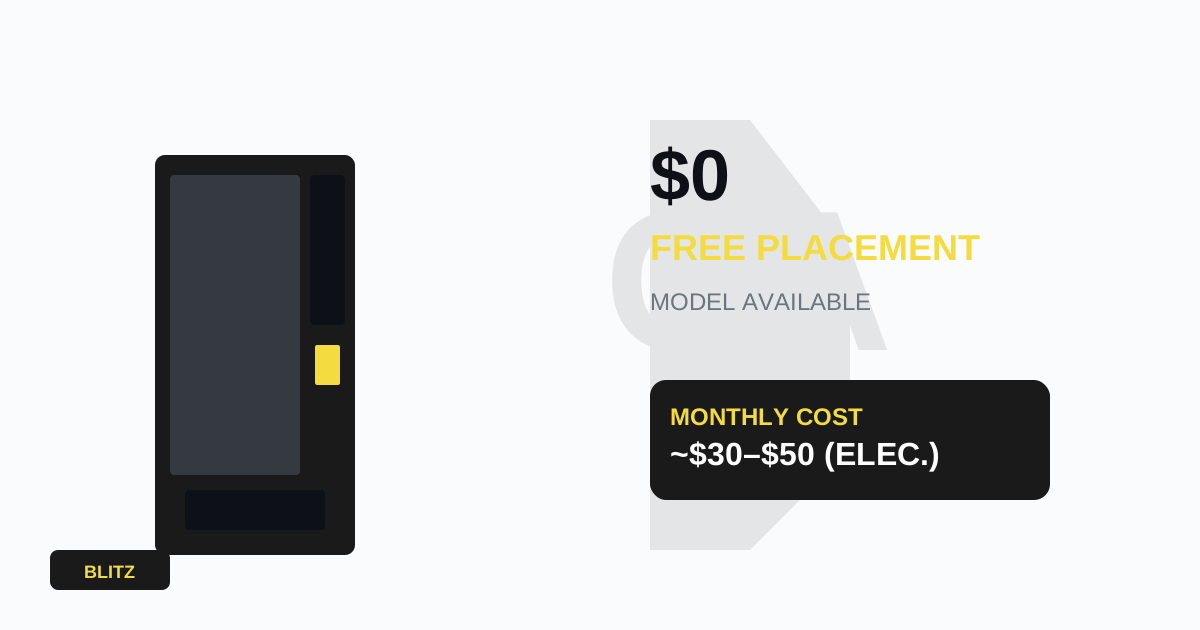
For most California businesses, professional vending machine service costs nothing upfront. Under the free placement model — the most common arrangement in the Bay Area — the vending provider installs, stocks, and maintains the machines at zero cost to you. The provider earns money through product sales. You get the amenity for free.
Bottom line for business owners:
- Free placement model: $0 to the business. Provider earns from product margins.
- Lease/rental model: $50–$200/month per machine depending on type and location.
- Full ownership: $3,000–$10,000 per machine upfront, plus ongoing stocking and maintenance costs.
For most California offices, warehouses, gyms, and healthcare facilities, free placement is the right answer — and it’s worth understanding exactly how it works before you sign anything.
Why Vending Pricing Is So Confusing
If you’ve searched for vending machine service costs in California and gotten vague or contradictory answers, you’re not alone. The vending industry has historically been opaque about pricing — large national providers like Canteen or Aramark rarely publish rates, and smaller regional operators give different quotes to different clients.
The confusion comes from the fact that there are actually three completely different business models in the vending industry, and providers don’t always explain which one they’re offering. Understanding the difference can save you from signing a contract that costs far more than you expected.
This guide breaks down every model clearly — what each costs, who it’s designed for, and what California businesses should watch out for.
The Three Vending Service Models
Model 1: Free Placement (Zero Cost to Your Business)
This is the model used by Blitz Vending Services and most professional full-service operators in the Bay Area. Here’s exactly how it works:
How the provider makes money: The vending company buys products wholesale and sells them retail through the machines. The margin between wholesale cost and retail price covers the machine, restocking labor, maintenance, and the provider’s profit.
What your business pays: $0
What your business gets:
- Machine installed at no cost
- Products stocked and restocked on a regular schedule
- All maintenance and repairs covered
- Modern cashless payment technology included
- Product mix customized to your workforce
Who this model is best for: Any business with consistent foot traffic — offices with 30+ employees, warehouses, hospitals, gyms, hotels, laundromats, schools, and retail spaces. The provider needs enough sales volume to cover their costs and generate margin.
The catch to watch for: Some providers use “free placement” as a hook but bury commission requirements, exclusivity clauses, or long lock-in periods in the contract. Always check the contract length, exit terms, and whether the agreement is exclusive (meaning you can’t bring in another provider). We’ll cover what to watch for in contracts later in this guide.
Model 2: Revenue Share (Partial Commission to Your Business)
Some vending providers, particularly in high-traffic locations like malls, airports, or large corporate campuses, offer the business a commission on sales in addition to free placement. This is common when the location generates very high sales volume.
How it works:
- Provider installs and manages the machine (free to the business)
- Business receives 5–25% of gross sales revenue as a commission
- This typically applies when monthly sales exceed $1,000–$2,000 per machine
Example for a 500-person office in San Jose: If a machine generates $3,000/month in sales and your commission rate is 10%, your business earns $300/month passively — while paying nothing for the machine or service.
Who this model is best for: Large facilities with very high foot traffic where the location generates significant sales leverage. Think corporate campuses, hospitals with hundreds of staff, large distribution centers, or hotel lobbies.
Important: Most Bay Area businesses do not qualify for revenue share under standard arrangements. It’s worth asking, but don’t make it a requirement for moving forward — the free placement model already gives you the amenity at zero cost.
Model 3: Machine Lease or Rental
Some operators — particularly those that don’t offer full-service management — lease machines to businesses that want to run their own vending operation.
What you pay: $50–$200/month per machine depending on machine type, age, and payment technology. High-tech combo machines or fresh food machines run higher.
What’s included: The machine only. You handle all stocking, maintenance, and payment processing.
True monthly cost breakdown for a leased machine:
| Cost Item | Monthly Estimate |
|---|---|
| Machine lease | $75–$150 |
| Product purchasing (wholesale) | $300–$600 |
| Restocking labor (your time or staff) | $50–$150 |
| Maintenance and repairs | $20–$50 |
| Payment processing fees | $15–$30 |
| Total monthly cost | $460–$980 |
Who this model is best for: Entrepreneurs starting a vending business who want to own the operation without buying machines outright. It’s rarely the right choice for a business that simply wants a vending amenity — the management burden and monthly costs make it inefficient when free placement is available.
Model 4: Full Machine Ownership
Businesses or operators that buy machines outright pay the highest upfront cost but own the asset and keep all revenue.
New machine prices in 2026:
| Machine Type | New Price Range | Used Price Range |
|---|---|---|
| Basic snack machine | $3,000–$5,000 | $800–$2,000 |
| Basic beverage machine | $3,500–$6,000 | $1,000–$2,500 |
| Combo snack + drink | $5,000–$8,000 | $1,500–$3,500 |
| Coffee vending machine | $4,000–$15,000 | $1,500–$5,000 |
| Fresh food machine | $8,000–$15,000 | $3,000–$6,000 |
Source: National Automatic Merchandising Association (NAMA) Industry Datasheet, 2025
Who this model is best for: Vending entrepreneurs or operators building a route business. Not recommended for businesses that simply want a vending machine as an employee or customer amenity — the capital investment, ongoing operational responsibility, and maintenance costs far outweigh the benefits when free placement is available.
What Factors Affect Vending Service Costs in California?
Even within the free placement model, several factors influence what arrangements are available to you — and what product pricing looks like in your machines.
1. Location and Foot Traffic
Providers in the Bay Area, Los Angeles, and San Diego can offer more flexible arrangements than those in rural Central Valley counties because higher population density = higher sales volume per machine. A San Jose tech campus with 200 employees will get better service terms than a Fresno agricultural office with 40.
Practical impact: In Bay Area markets, free placement is almost universally available for businesses with 30+ employees. In rural markets, minimum employee counts may be higher, or service frequency may be lower.
2. Machine Type
Not all machines have the same economics. A standard snack and beverage combo machine has lower operating costs than a fresh food machine or a specialty coffee machine. Providers can offer free placement more easily on standard machines because the margins are more predictable.
Fresh food machines and bean-to-cup coffee machines involve higher product costs, greater maintenance complexity, and faster spoilage — which is why some providers charge a monthly service fee for these even under a “free” arrangement.
3. Service Frequency
In high-density markets like San Francisco, San Mateo, and Santa Clara counties, machines can be restocked weekly because routes are efficient. In lower-density areas, restocking every two weeks is more common. More frequent restocking = better product freshness = higher machine performance.
4. Electricity
The one cost that always falls to the business: electricity. Modern vending machines use approximately $30–$50 per machine per month in electricity, based on an average of 7–10 kWh per day. California’s average commercial electricity rate of roughly $0.24/kWh in 2025 means a single machine costs about $40/month to run — a minimal cost for the amenity it provides.
Energy-efficient machines (Energy Star certified models) can reduce this to $20–$30/month.
5. Product Pricing in the Machine
This is where California businesses sometimes get surprised. Product prices in vending machines in the Bay Area tend to be higher than the national average — typically $1.75–$2.50 for a snack and $2.00–$3.50 for a beverage — because California has higher wholesale and distribution costs than most states.
This doesn’t affect your business directly under the free placement model, but it’s something employees will notice. A good provider calibrates prices to the local market and the spending profile of your workforce.
The Real Cost Comparison: Free Placement vs. Managing It Yourself
Let’s settle this with actual numbers. Assume a 100-person office in Oakland considering their options:
| Free Placement (Blitz) | Self-Managed Lease | Do Nothing | |
|---|---|---|---|
| Monthly cost to company | $0 | $460–$980 | $0 |
| Machine ownership | Provider | Leased | None |
| Stocking | Provider | You | None |
| Maintenance | Provider | You | None |
| Employee time saved | 15–20 min/day/person | 15–20 min/day/person | 0 |
| Electricity | ~$40/machine | ~$40/machine | $0 |
| Employee satisfaction impact | High | High | None |
| Management overhead | Zero | High | Zero |
For the vast majority of California businesses, free placement wins every time — same employee benefit, zero cost, zero management.
Red Flags to Watch in Vending Contracts
Even with a free placement provider, not all contracts are created equal. Before you sign, verify these points:
Contract length: Standard agreements run 1–3 years. Anything beyond 3 years without a performance exit clause should raise a flag.
Exclusivity: Most providers require exclusivity — meaning you can’t bring in a competing vending service. This is normal. What’s not normal is exclusivity extending to micro-markets or coffee services that the provider doesn’t offer.
Service guarantees: What happens if a machine is broken for 3 days? 7 days? A quality contract specifies response time SLAs (service level agreements) — typically 24–48 hours for repairs in California urban markets.
Price adjustment clauses: Some contracts allow the provider to raise product prices annually without your approval. Request language that requires notification and mutual agreement on material price changes.
Commission thresholds: If revenue share was discussed, make sure the threshold and percentage are spelled out clearly — not implied.
Exit conditions: What happens if your business closes, downsizes significantly, or moves? A good provider will have reasonable early exit terms tied to meaningful change-of-circumstance conditions.
What Blitz Vending Offers California Businesses
Blitz Vending Services operates on the free placement model across the Bay Area. Here’s what’s included at no cost:
- Machine installation and setup
- Custom product selection based on your workforce profile
- Regular restocking (weekly or bi-weekly based on volume)
- All maintenance and repairs — typically within 24–48 hours
- Modern cashless payment (tap-to-pay, Apple Pay, Google Pay, credit cards)
- Account management and product mix optimization
We serve offices, warehouses, medical facilities, gyms, hotels, laundromats, schools, and more. If your location has consistent foot traffic, we can almost certainly make it work.
To understand your specific options — including whether revenue share makes sense for your location — contact our team for a free consultation. We’ll assess your space and give you a straight answer within 24 hours.
You can also learn more about our installation process, restocking service, and maintenance coverage.
Frequently Asked Questions
How much does vending machine service cost for a small business in California?
For most small businesses with 30–50 employees, vending machine service is free under the placement model. You provide the space and electricity (~$40/month). The provider handles everything else. If your location has fewer employees or lower foot traffic, some providers may not service it — but Blitz works with businesses of varying sizes across the Bay Area.
Do I have to pay for the vending machine itself?
No, under free placement you don’t pay for the machine. The vending provider owns the machine and places it at your location at their own expense. You have no upfront cost and no capital outlay.
Can I make money from having a vending machine?
Yes, through a revenue share arrangement. If your location generates high enough sales volume — typically $1,500+ per machine per month — providers will often offer a commission of 5–20% of gross sales. Ask specifically about this when evaluating providers.
What’s the difference between free vending and a vending machine business?
Free vending means you’re the host location receiving a service at no cost. A vending machine business means you own and operate machines yourself to generate income. These are completely different arrangements. If you’re interested in starting a vending route business in California, that’s a separate topic — but hosting a machine in your business is not the same thing.
How do vending machine prices in California compare to other states?
Product prices in California vending machines tend to run 15–25% higher than the national average due to California’s higher minimum wage, distribution costs, and California-specific regulations. Expect snacks at $1.75–$2.50 and beverages at $2.00–$3.50 in Bay Area markets.
What happens if I want to cancel my vending service contract?
This depends entirely on your contract terms. Standard agreements run 1–3 years. Early termination without cause typically requires 30–90 days notice and, in some cases, a fee. Always read the exit clause before signing, and make sure it includes reasonable change-of-circumstance provisions.
Is there a minimum number of employees needed for free vending service?
Most Bay Area providers require a minimum of 30–50 employees or equivalent foot traffic to justify free placement. Blitz evaluates each location individually — contact us to discuss your specific situation.
The Bottom Line
For California businesses considering vending service, the answer to “how much does it cost?” is almost always: nothing, if you choose the right model and provider.
The free placement model is well-established, widely available across the Bay Area, and genuinely costs your business nothing beyond electricity. The machines, products, restocking, and maintenance are all covered by the provider.
What you’re really evaluating is not cost — it’s which provider offers the best service, the right product mix, and a contract you’re comfortable with.
Ready to see what a free vending setup looks like for your California business? Contact Blitz Vending Services today for a no-obligation consultation.